
Azores to Ireland | Day 5
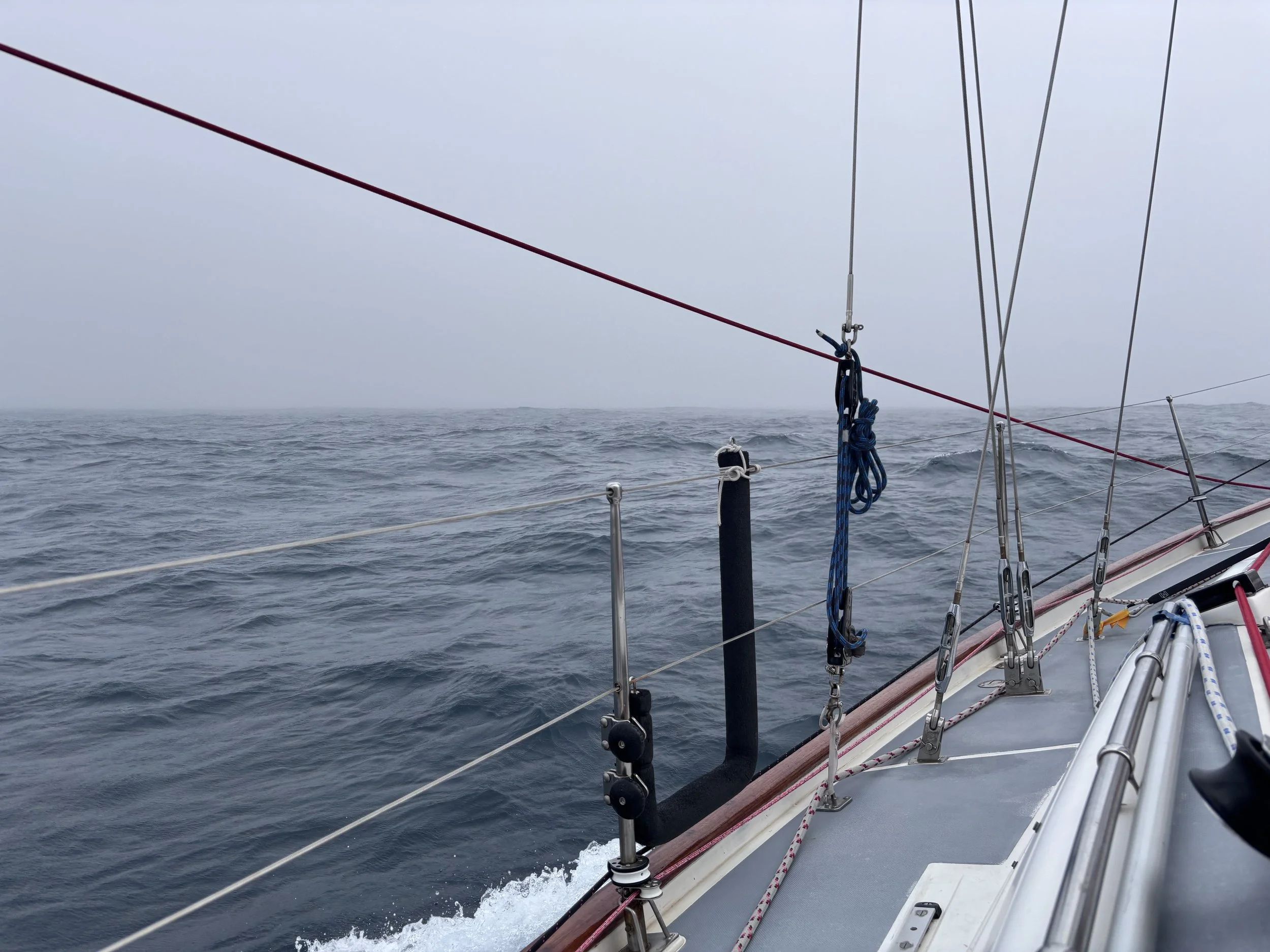
Foggy morning
Yesterday was another great day of sailing! The weather has been beautiful. Slightly cool and overcast. We have even had periods of fog. The winds were consistent at 15kts. The seas were settled, with swells around 3 or 4 feet at 6- or 7-second intervals. We sailed wing-on-wing—the main sail out to port (left) and the headsail out to starboard (right), attached to a pole to keep it filled. An added bonus is that we had around 1kt of current with us for most of the day, adding a knot to our speed. Remedy glided through the entire day effortlessly. It was probably one of the most relaxing days on passage since leaving the States. We even watched a movie, not a very good one, but it was still enjoyable to be able to relax for a while.
Yesterday morning, as I sat in the cockpit, staring out at the vast ocean (the only thing you can look at), I saw a large black dorsal fin emerge from the water. Then another. And another. Next thing I knew, a pod of large mammals was swimming straight for us and with great speed.
This made my heart flutter just a bit because of a phenomenon that has been occurring with Orcas since around 2020. Orcas have been attacking the rudders on sailboats in the Straits of Gibraltar, and off the coasts of Portugal, Spain, Tangiers, and even as far north as France—though most have occurred in the vicinity of the Straits of Gibraltar. There have been more than 800 documented interactions—damaging most vessels, disabling some, and sinking a few.
In fact, some friends we made in Horta sailed to Gibraltar a few weeks ago. Their boat was attacked by Orcas for over an hour. Thankfully, their rudder remained intact. The Orcas did break their autopilot arm, but they thankfully had a spare, repaired it, and made it safely to harbor.
Scientists have been studying this for a few years, but have not been able to determine what underlies the behavior. Their leading theory is that a group of bored juveniles is playing with the boats because the behavior occurs when tuna are plentiful, and they don't have to work as hard to hunt for food. There are other theories too, of course—things like an Orca was wounded by a ship’s rudder and now they are all seeking revenge. But it has sailors who are transiting the area on high alert. No interactions or attacks have been recorded out where we are, so I knew it was highly unlikely, but when I saw a pod of large black mammals swimming straight for us with great speed, it did make my heart flutter ever so slightly.
As their bodies arced through the water, we saw they had large, bulbous heads. And with a little research, we determined that they were long-finned pilot whales. There were around 10 in the pod, swimming right toward the boat. As they came closer, they surfed the waves around the boat for a minute or so and then passed astern of us (behind us).
Nature is wild and getting to observe it in its natural environment is one of the things that makes the hard parts of sailing so worth it. Here is a video I captured. (Again, if you are reading this from your email, you’ll have to click this link to watch it on our website. )
All in all, it was an uneventful day with no major issues. We are still having a problem with our bilge pump, which stopped working again last night. But Ken quickly diagnosed and put another temporary workaround in place. It appears the root cause is a wiring issue, which we will have to repair once we arrive in Ireland. But for now, it is working.
We are officially halfway. Four more days to go. We should arrive in Ireland sometime Monday. And I cannot wait to enjoy a proper Shepherd’s Pie!
All is well!
Living untethered, but held fast.
Day Five Stats:
Total Nautical Miles Sailed 142
Average Boat Speed 5.9kts
Max Boat Speed 8.3kts
GPS Coordinates 49 09.786N 22 33.252W
Miles to go: 525